Basement Flood Damage Restoration in Miami, FL
A flooded basement can leave standing water, soaked flooring, damaged walls, wet belongings, and moisture trapped beneath or inside building materials.
Rapid Dry Miami provides basement flood damage restoration, flood water removal, cleanup, drying, and repair for residential and commercial properties affected by lower-level flooding.
When water accumulates in your basement, prompt water removal, deep extraction, and structural drying prevent long-term structural issues and protect your property.
Dealing with a flooded basement in Miami? Call Rapid Dry Miami for emergency flood extraction.
A Flooded Basement Can Have More Damage Than You Can See
Because basements sit at the lowest elevation of a property, water naturally gathers and pools across the entire floor area. What looks like several inches of standing water on a concrete or finished floor can quickly penetrate deep into surrounding building assemblies.
Water seeps beneath flooring, wicks up drywall partitions, saturates insulation, and gets trapped against foundation walls. Removing standing water is only the first step—unresolved moisture left behind can lead to structural deterioration and persistent musty odors.
How Water Affects a Flooded Basement:
A flooded basement commonly affects:
- Standing water on basement floors: Heavy accumulation across concrete, tile, or carpeted areas.
- Water beneath flooring: Trapped moisture holding in underlayment, carpet padding, and slab crevices.
- Wet carpet & padding: Waterlogged fibers and sponge-like padding holding gallons of liquid.
- Damaged drywall & baseboards: Sheetrock drawing water upward through capillary action.
- Damp insulation inside walls: Saturated fiberglass or foam batting concealed in wall cavities.
- Furniture & stored belongings: Cardboard boxes, seasonal items, and furnishings in contact with water.
- Persistent musty odors: Lingering damp smells caused by trapped moisture in cool basement air.
Core Rule: Removing the water you can see is only the beginning. Moisture can remain beneath flooring, inside walls, and within other basement materials long after the floor appears dry.
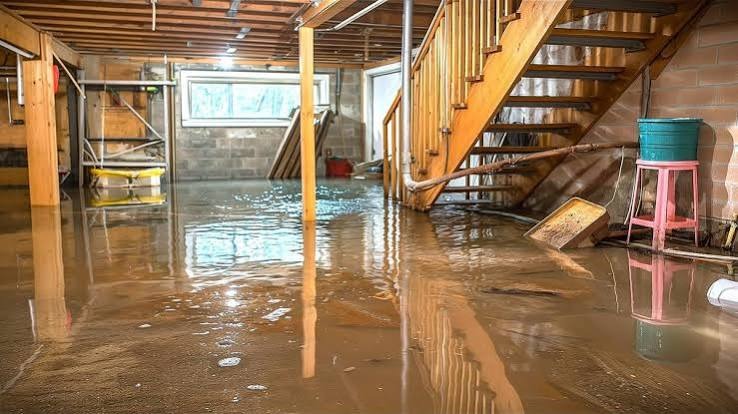
Standing floodwater accumulating beneath basement stairs and soaking structural slabs.
What Causes Basement Flooding in Miami?
Lower-level spaces and basements in South Florida are vulnerable to water intrusions from weather events, plumbing failures, and hydrostatic pressure:
Heavy Rainfall
Large volumes of rain during tropical downpours can overwhelm perimeter yard grading and municipal drainage, causing water to pool against foundation walls and seep into lower levels.
Storm and Hurricane Flooding
Tropical storms and hurricane storm surges generate elevated ground saturation and wind-driven water intrusion that enters through basement windows, entry doors, and structural vents.
Drainage Problems
Clogged exterior French drains, failed sump pumps, or overflowing gutter downspouts allow rainwater to collect directly against the foundation slab and force its way inward.
Plumbing Leaks and Burst Pipes
A cracked supply pipe, ruptured water heater tank, or broken overhead plumbing line can release hundreds of gallons of pressurized water directly into the basement within hours.
Sewer or Drain Backups
When city sewer lines or private waste stacks become blocked or surcharged, wastewater can back up through basement floor drains and fixtures. For sewage contamination, visit our dedicated Sewage Backup Cleanup Miami page.
Foundation or Exterior Water Intrusion
High South Florida groundwater tables exert hydrostatic pressure against below-grade walls, pushing water through micro-cracks in concrete masonry, window wells, and construction joints.
What Does Basement Flood Damage Restoration Include?
Our comprehensive basement restoration service covers the complete continuum from initial emergency water removal to final material repairs and restoration:
Basement Flood Water Removal
Pumping out standing floodwater from concrete floors, basement utility rooms, and storage areas using heavy-duty submersible pumps.
Basement Water Extraction
Deep mechanical extraction of water trapped in carpet padding, laminate subfloors, and porous concrete slab foundations.
Basement Flood Cleanup
Cleaning affected surfaces, removing flood debris, washing concrete slabs, and applying antimicrobial sanitization where required.
Structural Drying
Deploying commercial LGR dehumidifiers and high-velocity air movers to draw out moisture trapped inside concrete, framing, and drywall.
Moisture Assessment
Mapping hidden dampness using digital moisture meters and thermal imaging behind finished basement walls and subflooring.
Flood Damage Repair
Evaluating affected materials to perform targeted repairs, drywall patching, baseboard replacement, and flooring restoration.
Basement Restoration: Returning to Usable Condition
After extraction and structural drying are completed, we help transition your basement back to a safe, clean, and fully functional living or storage space.
Our Basement Flood Damage Restoration Process
We follow an orderly, systematic 9-step restoration sequence designed to eliminate standing water, extract trapped moisture, and restore the lower level:
Assess Flood Damage
Identify where water entered and inspect all affected basement zones, subfloors, walls, and stored items.
Identify Water Source
Determine whether flooding stems from rain, stormwater runoff, plumbing breaks, or sewer backflow.
Remove Standing Water
Deploy high-capacity trash pumps and submersible extractors to rapidly clear standing water pools.
Extract Absorbed Water
Pull trapped liquid from carpet fibers, underlying padding, laminate underlayment, and concrete slabs.
Clean the Basement
Clean affected surfaces, remove flood sediment or debris, and apply antimicrobial sanitization.
Dry Affected Materials
Establish high-velocity airflow and industrial dehumidification grids to draw moisture from the structure.
Assess Damage
Evaluate drywall, insulation, baseboards, cabinets, and flooring to identify repair versus replacement needs.
Complete Necessary Repairs
Execute targeted repairs including drywall patching, baseboard replacement, and flooring fixes.
Move Toward Restoration
Restore the basement as the final stage of the process, ensuring a clean, dry, pre-damage condition.
Basement Flood Damage Cleanup
A comprehensive basement cleanup involves much more than pumping out standing water. Floodwaters bring silt, debris, and residual moisture that require thorough attention:
Standing Water Cleanup
Clearing accumulated water from basement low spots, utility areas, sump pits, and floor drains using commercial-grade extraction units.
Flood Debris Cleanup
Removing sediment, mud, fallen insulation, degraded packaging, and debris brought in by exterior stormwater or structural water intrusions.
Flooring Cleanup
Deep cleaning and assessing carpet fibers, padding, concrete floor slabs, and hard surface floor coverings to remove water residues.
Wall and Surface Cleanup
Washing and treating affected drywall, wood framing, baseboards, and foundation concrete walls to prevent surface staining and odors.
Belongings and Stored Items
Evaluating stored boxes, seasonal goods, tools, and basement furnishings to separate cleanable personal items from unsalvageable contents.
Cleaning and Disinfection
Applying appropriate EPA-registered antimicrobial and disinfection solutions tailored to the specific category and source of the floodwater.
Basement Flood Damage Repair
Once water removal and structural drying are complete, affected building materials are evaluated to determine what can be preserved versus what requires targeted repair or replacement:
Flooring Repair
Evaluating saturated carpet padding, buckled laminate seams, and subfloor underlayment for repair or reinstallation.
Drywall & Wall Repairs
Assessing waterlogged sheetrock to perform precision flood cuts, drywall patching, and surface refinishing.
Baseboard & Trim Repair
Replacing warped wooden molding or vinyl base trim that trapped moisture along bottom wall plates.
Cabinet & Built-In Repairs
Evaluating swollen toe kicks, particleboard shelving, and built-in basement storage assemblies.
Insulation Assessment
Inspecting wet fiberglass or cellulose insulation inside basement wall cavities for proper replacement.
Subfloor Damage
Checking concrete slab integrity and plywood subfloors beneath finished floors to ensure complete stability.
Core Restoration Sequence: Remove Water → Extract Moisture → Structurally Dry → Assess Materials → Repair or Replace Where Necessary.
Where Basement Floodwater Can Hide
Because basements have cooler temperatures, high ambient humidity, and concrete foundations, water that enters does not easily evaporate. Instead, it conceals itself in hidden spaces.
A basement can look dry on the surface while substantial moisture remains inside or beneath affected building materials.
Hidden moisture commonly conceals itself:
- Under carpet & padding: Trapped water between backing and cold concrete slabs.
- Under finished flooring: Moisture trapped beneath vinyl planks, laminate, and tile.
- Inside subflooring: Plywood or sleeper systems holding absorbed floodwater.
- Behind baseboards & drywall: Moisture wicking up wall studs and base plates.
- Inside wall cavities & insulation: Concealed dampness behind finished walls.
- Beneath stored belongings: Water trapped under cardboard boxes, bins, and furniture.
- Around basement fixtures: Trapped dampness around water heaters, sinks, and sump basins.
Learn how we eliminate deep structural dampness on our dedicated Structural Drying Miami page.
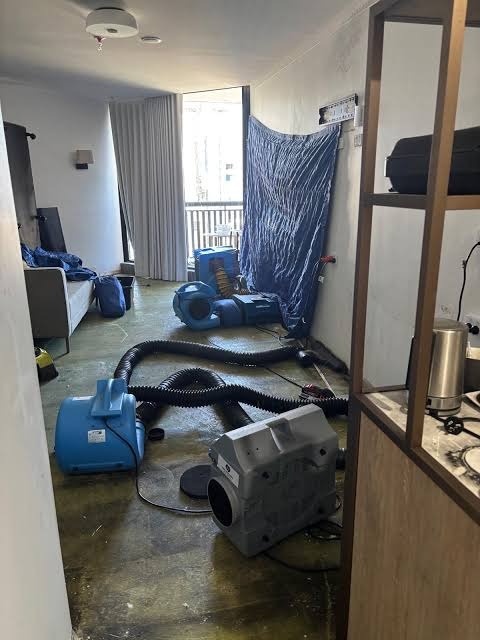
Extracting hidden moisture from finished basement walls, subfloors, and framing.
Basement Flooring After a Flood
Different basement flooring types interact uniquely with floodwater. The proper mitigation approach depends on water exposure time and subfloor construction:
Carpet and Carpet Padding
Water remains trapped between carpet fibers and the concrete floor beneath. Deep mechanical extraction is required to pull liquid from both carpet and pad before targeted airflow can dry the backing.
Hardwood Flooring
Moisture affects wood planks from the underside, leading to cupping and crowning. Specialized floor drying mats draw trapped moisture directly from boards and concrete subfloors.
Laminate Flooring
Floodwater enters through interlocking seams and reaches composite fiberboard cores. Early moisture evaluation determines whether sections can be dried or require replacement.
Tile Flooring
Water moves through porous grout lines and perimeter expansion joints, settling into thin-set mortar and the concrete foundation slab beneath.
Vinyl Flooring
Luxury vinyl planks and sheet vinyl create an impermeable top layer. If water gets underneath through edges, it remains trapped against the slab without professional drying.
Basement Flood Damage to Walls and Ceilings
Water entering a basement at floor level wicks rapidly into drywall, baseboards, and wall cavities. Conversely, water from upper plumbing breaks or ceiling leaks travels downward through joists and wall assemblies.
Assessing the full vertical extent of moisture penetration is essential to ensure framing studs, insulation batts, and paint finishes are thoroughly dried.
Wall and ceiling components affected by basement flooding:
- Drywall & Sheetrock: Porous gypsum cores absorbing water vertically above floor level.
- Baseboards & Trim: Swollen wood or vinyl trim trapping moisture along the wall base.
- Wall Cavities & Studs: Wood framing and metal tracks holding concealed dampness.
- Cavity Insulation: Saturated fiberglass batts losing thermal rating and retaining moisture.
- Ceiling Materials: Joists and ceiling panels affected by overhead pipe breaks.
- Paint & Finishes: Bubbling paint, peeling wallpaper, and water stains along wall lines.
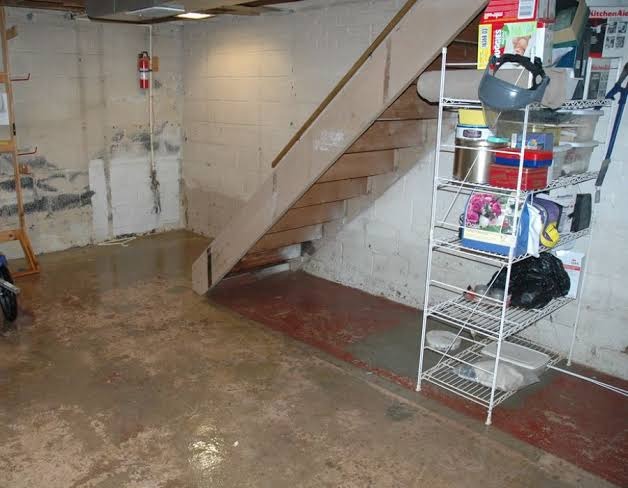
Water stains and moisture lines along basement concrete foundation walls.
Basement Flood Damage to Furniture and Stored Belongings
Basements are primary storage areas for furniture, seasonal decorations, archived documents, clothing, and household supplies. When water enters, items stored directly on the floor are immediately affected.
Evaluating stored goods promptly helps determine which belongings can be dried, cleaned, and preserved versus items that have suffered irreversible saturation.
Stored items commonly impacted during a basement flood:
- Upholstered & Wood Furniture: Couches, chairs, desks, and shelving units.
- Cardboard Storage Boxes: Boxes absorbing standing water and compromising contents.
- Clothing & Seasonal Goods: Garments, winter wear, and holiday decorations.
- Storage Containers: Plastic bins with water seepage around lids or seals.
- Basement Appliances: Freezers, washers, dryers, and dehumidifier units.
- Personal Belongings & Keepsakes: Photos, documents, and memorabilia.
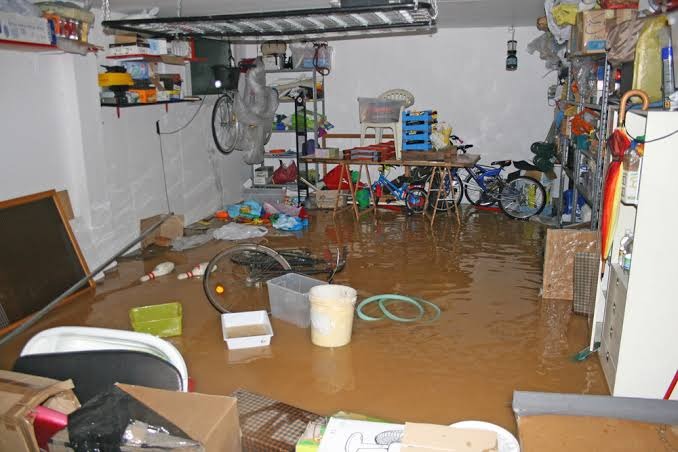
Submerged storage boxes, household belongings, and furniture in flooded basement.
Signs Your Basement Still Has Flood Damage
If your basement experienced previous flooding, watch for these common indicators of residual moisture:
Musty Basement Odor
Persistent damp, earthy smells circulating in lower-level rooms.
Damp Flooring & Carpet
Carpet or tiles that feel cool, moist, or leave socks wet after walking.
Swollen Floorboards
Hardwood or laminate planks with raised, cupping, or crowning edges.
Soft Spots on Floors
Spongy subfloor areas that give way slightly under foot pressure.
Water Stains on Drywall
Discoloration, brown rings, or peeling paint along lower wall sections.
Damp Baseboards & Moldings
Trim separating from wall bases with trapped dampness behind.
Persistent High Humidity
Relative humidity levels remaining above 60% in basement air.
Water Reappearing After Rain
Moisture seeping through slab joints following heavy South Florida rain.
Damp Wall Insulation
Elevated moisture meter readings inside insulated wall cavities.
Basement Flood Damage Restoration vs. Basement Flood Cleanup
Understanding the difference between cleanup and full restoration ensures appropriate steps are taken:
Basement Flood Cleanup
Primarily focuses on immediate physical mitigation:
- Removing standing floodwater and accumulated sludge
- Clearing flood debris and contaminated materials
- Washing and sanitizing affected hard surfaces
- Cleaning and sorting personal belongings
- Preparing the basement environment for drying equipment
Basement Flood Restoration
Encompasses the broader, end-to-end technical recovery:
- Comprehensive initial moisture mapping and source control
- High-volume water removal and deep extraction
- Intensive industrial structural drying and dehumidification
- Continuous moisture tracking to verify dry standards
- Material assessment and targeted repair/restoration
Basement Flood Damage Restoration After Heavy Rain or a Hurricane
Miami properties experience intense tropical storms, hurricanes, and severe rainstorms that saturate the ground. Hydrostatic pressure forces water through below-grade foundation walls, window wells, and doorways.
Weather-related basement flooding leaves both visible water and trapped moisture in building materials:
- Exterior stormwater entering through doorway thresholds and ground-level windows
- High water tables forcing groundwater through basement concrete slab seams
- Overwhelmed municipal drainage causing storm line backflows into lower fixtures
For general property flooding, visit our dedicated Flood Damage Restoration Miami service overview.
Residential Basement Flood Damage Restoration in Miami
Our residential services are tailored specifically to the unique layouts and living spaces found in single-family homes, townhouses, and condos with lower-level areas:
Finished Basements
Protecting drywall, entertainment areas, home theaters, and finished flooring.
Storage Basements
Extracting standing water and salvaging stored personal goods, bins, and seasonal items.
Basement Laundry Areas
Mitigating washer supply line ruptures and floor drain backups around laundry machines.
Utility & Furnace Rooms
Clearing water from around water heaters, electrical panels, and HVAC equipment.
Basement Home Offices
Drying workstations, office furniture, carpet tiles, and technology workspaces.
Finished Living Spaces
Restoring bedrooms, guest suites, and bathrooms located in below-grade spaces.
Commercial Basement Flood Damage Restoration
Commercial facilities in Miami frequently utilize lower-level spaces for vital operations, inventory storage, and utility infrastructure:
- Commercial storage areas: Protecting lower-level stockrooms, archived files, and supplies.
- Lower-level offices: Rapid extraction and drying for employee workstations and meeting rooms.
- Inventory storage: High-volume water removal to protect merchandise and warehouse pallets.
- Equipment rooms: Drying boiler rooms, elevator shafts, electrical vaults, and server rooms.
Basement Flood Damage Restoration Across Miami
Rapid Dry Miami provides basement flood damage restoration, cleanup, and structural drying across Miami, Miami Beach, Coral Gables, Coconut Grove, Brickell, Hialeah, Kendall, Doral, North Miami, and surrounding Miami-Dade County communities.
Basement Flood Restoration Across Miami-Dade
Fast, professional water extraction, cleanup, structural drying, and damage repair for flooded basements and lower-level spaces throughout Miami.
Areas We Serve
Select a Miami-Dade community below to view local flood restoration capabilities:
Miami
Flood cleanup and restoration for homes, condos, apartments, and businesses throughout Miami.
Serving Miami-Dade County
If your property has experienced flooding and your community isn't listed above, Rapid Dry Miami may still be able to help. Contact us to discuss your location and the type of flood damage affecting your property.
Need Flood Damage Restoration in Miami?
Call Rapid Dry Miami today for 24/7 assistance.
Why Choose Rapid Dry Miami for Basement Flood Damage?
Restoring a flooded basement requires specialized knowledge of below-grade moisture dynamics and high-capacity equipment:
Focused on Basement Flood Damage
Our mitigation protocols are centered on the unique challenges created when water enters lower-level and below-grade spaces.
Water Removal and Deep Extraction
We handle both bulk standing floodwater pumping and water absorbed deep into carpet padding, underlayment, and concrete slabs.
Comprehensive Basement Cleanup
We clean affected areas, remove flood debris, wash concrete foundations, and sanitize surfaces appropriately.
Attention to Hidden Moisture
We inspect beyond visible surfaces, testing subflooring, wall cavities, framing, and insulation to eliminate trapped moisture.
From Cleanup to Repair and Restoration
We guide your property through the entire recovery process, from initial water extraction to final repairs and full restoration.
Frequently Asked Questions
Clear answers to common questions regarding basement flooding, water extraction, cleanup, drying, and damage repair in Miami.
Frequently Asked Questions About Flood Damage Restoration in Miami
Got questions about our services? Here are some common inquiries we receive from Miami-Dade property owners.
Need immediate emergency assistance?
(786) 434-061624/7 Live Operator • < 45 Min Dispatch in Miami-Dade
Prioritize safety first: avoid walking into standing water if electrical outlets, appliances, or extension cords are submerged. Shut off power to the basement at the main breaker if safely accessible from a dry area. If the water source is an active plumbing leak, turn off the main water valve. Avoid touching contaminated water, and contact a professional restoration company to begin immediate water extraction and drying.
Need Basement Flood Damage Restoration in Miami?
A flooded basement can leave standing water, damaged flooring, wet walls, affected belongings, and moisture hidden beneath the surface.
Call Rapid Dry Miami for basement flood damage restoration, cleanup, water removal, drying, and damage repair.